
Tambú – The Heartbeat of Curaçao’s African Heritage
Tambú is one of Curaçao’s oldest and most powerful forms of musical and cultural expression. Born from the African traditions carried to the Caribbean during slavery, tambú became both a rhythm and a language of resilience. Through its deep drumbeats, call-and-response singing, and percussive dance, tambú gave enslaved and marginalized communities a way to express emotion, resistance, and unity when words alone could not.
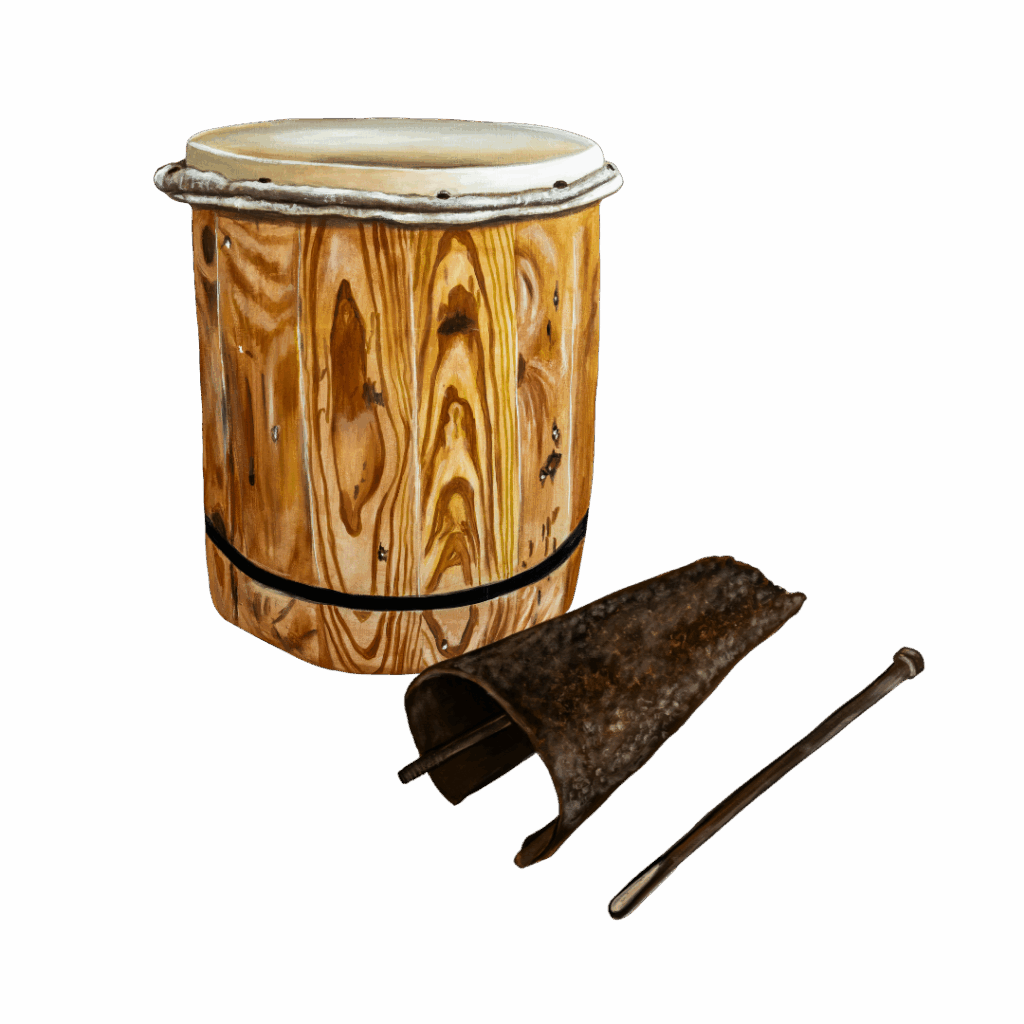
At its core is the tambú drum, carved from wood and covered with goatskin, played by hand or with rhythmic stomps on the ground. The drum’s pulse drives the kantadó (lead singer), who improvises verses that speak of love, hardship, social injustice, and daily life. The audience responds in chorus, creating a living dialogue between performer and community.
For many years, tambú was forbidden—its sensual movements and raw energy viewed as rebellious. Yet even in secrecy, the rhythm endured. It passed from generation to generation, evolving from a form of resistance into a celebration of identity.
Today, tambú is recognized as a vital part of Curaçao’s intangible heritage. It is performed at festivals, cultural gatherings, and in spaces like the Museo di Tambú Shon Colá, where its history and instruments are preserved. More than just music, tambú is the sound of survival, pride, and the unbroken spirit of the Curaçaoan people.
Tambú is not merely a dance, as it was trivialized by colonial governments, wealthy white people, and the Roman Catholic mission. Instead, it is a way of life for Afro-Curaçaoans. Nor is it a simple form of public entertainment for passing time and having fun, as it was described by colonial legislators.
Tambú belongs to the beliefs of the people. It is an expression of the Black slaves of Curaçao, and after their liberation in 1863, of the Afro-Curaçaoan workers and poor farmers. Tambú is part of the complexity of Afro-American worship, linked by history and religion, that arose everywhere as a consequence of the forced and massive migration of Africans during slavery.
Other comparable popular expressions include the calinda of Trinidad, Winti of Suriname, Palo Monte of Cuba, Candomblé and Macumba of Brazil and Bomba and Plena of Puerto Rico.
Tambú music uses only two instruments: a membranophone one-headed drum (Tambú) and an iron idiophone (heru). An essential part of tambú music is the clapping of hands (brasa) and stomping of feet. The barí is the central instrument, played by men, while the main singing part was always handled by women.
Sung words are one of the most principal aspects of Tambú. The musical accompaniment plays a supporting role.
The origin of the word “Tambú”
The word Tambú first and foremost refers to the barí, a type of drum. The drum’s head is typically made of stretched sheepskin.
Tambú is classified as a membranophone with a barrel shape. However, the word has more meanings. It can also refer to a fiesta or Pleizi, which came from the Dutch word plezier, meaning pleasure, an event where Tambú music is played. The phrase “ban tambú” means “let’s go to the activity where we play, sing, and dance Tambú.” A third meaning is a musical genre. Tambú has a fixed basic rhythm in 12/8 time, which also took on the name Tambú. Finally, the word also refers to the dance itself.
The fact that a single word describes multiple facets of the same social phenomenon points to the strong social integration typical of West Africa and Curaçao. In these cultures, dance, song,
music, religion, and social organization are all deeply connected. Over the centuries, people who practiced this art form created synonyms for it: barí, tobo, kueru, boko, tambú di sanka, and pleizí.
The European vs. African Origin Debate
Several authors have suggested that the word tambú has a European origin. The ethnomusicologist E. Palm assumes the origin of the music and dance must be sought in Africa. He categorizes Tambú as Antillean music that, in its melody, form, and rhythm, is of African origin. However, he concludes that the word tambú is derived from the Dutch word ‘tamboer’ (drummer).
One would expect Palm to look for the origin of the word tambú among the numerous African languages, given that he states the dance’s origin is African. At first glance, Palm’s view seems plausible for Curaçao, where Dutch is still an official language. But when we consider our socio-historical past, this doesn’t seem to be the most logical or probable explanation. Investigators often search for solutions in Dutch or European equivalents when trying to explain hard-to-define cultural phenomena. People often try to apply European models and ideas to local issues. This is generally incorrect because the starting point for a country’s development and achievements should be its own history. It’s still not customary to consult relevant African sources—which are scarce in the Western world—or Caribbean sources.
Ganzemans acknowledges a possible African origin for Tambú. However, he also states that the name tambú could be derived from European languages, either the French word ‘tambour’ or the Dutch word ‘tamboer’. According to Ganzemans, the synonym barí indicates a Spanish origin.
The fact that this popular expression has all the characteristics of African descent justifies, in my opinion, an investigation into a possible African origin for the word itself. Many very old and original customs in Curaçao, such as chiwewe, zámana kitoki (pole dance), seú, èzè, and tambú, date back to the 18th and 19th centuries, during the time of enslaved people in Curaçao who were born in Africa. To understand the roots of these specific traditions, one must explore African sources in addition to Caribbean and European ones. For example, the word tambú
appears in ancient Congo in the form of ‘ntambu’. The Africans who were brought to Curaçao came from the territory of Congo (Costa Luango) as well. These enslaved people were most likely descendants of the Bantu culture. Ciparisse also mentions the West Congo word ‘ntambu’ as the name for the nailed, single-headed membranophone.
In his work Vivencia de un rito luango en el tambú, Dominguez states that the enslaved people who settled in Curaçao came from Luango. Luango was a territory in the former French Congo, located on the Kuilu, Luemma, and Chiluango rivers, also known as Luango, Luce, and Cacongo. Parts of it may have belonged to Portugal in the 18th century. Luango is on the coast and was the capital of an indigenous kingdom.
A Deeper Meaning
In English, ‘ntambu’ can mean “a trap,” “a lock,” and “a bolt.” In these meanings, one can see a certain similarity. For example, trap, lock, bolt, and jam are all similar in meaning. They all mean something that closes, secures, or holds something or someone captive. Also, the meanings ‘gara’ (to grasp) and ‘klap’ (a slap) imply an activity—an attack or defense.
If we analyze the three English words as verbs, we find: to trap means to catch in a trap; to lock means to secure, lock, or jam; and to bolt means to secure with a bolt or to run away.
This is a very insightful analysis of the semantic range of three English words—trap, lock, and bolt—and their corresponding translations in Papiamentu.
You have effectively identified a core meaning or semantic field that connects many of their translations: the concept of enclosure, containment, or constraint.
Here is a summary of your analysis, reinforcing the discovered semantic similarities:
TRAP | trampa, kui, kanaster, klèm (snare, trap, basket, clamp) |
LOCK | slòt, lòk, kandal, slùis, gara (lock, padlock, bolt, sluice, grab) |
BOLT | klap (di bos), bout, rèndu, tranka (clap/crack, bolt/screw, bolt/bar, bolt/bar) |
Semantic Group | Papiamentu Examples | Core Action |
Containment/Enclosure | trampa, kui, kanaster, slòt, slùis, rèndu, tranka | To prevent escape or movement. |
Active Constraint | klèm, gara | To hold something tightly or firmly. |
To trap | kue den trampa (catch in a trap) | Containment/Capture |
To lock | sera, lòk, klèm (close, lock, clamp) | Closure/Constraint |
To bolt | tait, pone un rèndu, kore ku (tighten, place a bar, run away/flee) | Constraint/Escape (Active Closure) |
This is the oldest form, often performed during gatherings in private yards or community settings.
Focus: Rhythm, call-and-response singing, and social or emotional storytelling.
Instruments: The tambú drum, chapi (hoe blade), wiri (scraper), and handclaps.
Movement: The dance is symbolic—partners move sensually but never touch, emphasizing control and respect.
Themes: Everyday life, love, betrayal, struggle, and social commentary.
Emerging from cultural festivals and stage performances in the mid-20th century, this style adapts tambú for public and professional presentation.
Focus: Choreography, vocal harmony, and showmanship.
Instruments: Sometimes includes additional percussion or melodic instruments (like guitar or bass) for performance impact.
Setting: Cultural festivals, theater productions, and educational demonstrations.
Goal: To preserve tambú while making it accessible to wider audiences, especially tourists and younger generations.
A more recent development, tambú fusion blends traditional rhythms with contemporary genres like jazz, reggae, or pop.
Artists: Modern musicians and producers experiment with tambú beats and chants, bringing its pulse into radio and stage music.
Goal: To evolve the sound without losing its identity.
Example: Tambú influences can be heard in Curaçaoan and Aruban music styles like tumba and seú, which share rhythmic roots.
Tempo: 80–100 BPM (slow, grounded rhythm)
Meter: 6/8 or free rhythm
Typical Pattern (Drum):
| BOOM – TAP – | BOOM – BOOM – TAP – |
The tambú (drum) keeps a deep pulse, played by sitting on the drum and striking with the hands and heel.
The chapi (iron hoe blade) provides a sharp metallic “ting–ting–ting” counter-rhythm, usually off-beat.
Example lyric (call and response):
Lead (kantadó):
“Mi ta sinti dolor den mi kurason”
(I feel pain in my heart)
Chorus:
“Tambú ta mi konsuelo”
(Tambú is my comfort)
Mood: Earthy, emotional, storytelling; often improvised.
Tempo: 100–120 BPM
Meter: 4/4 or 6/8 hybrid
Instrumentation: Tambú drum, chapi, wiri, bass, guitar, sometimes brass.
Rhythmic pattern:
Kick (Tambú): | BOOM – – BOOM – |
Chapi: | x x x x x x | (steady offbeat)
Wiri: | . sh . sh . sh |
Example lyric:
Lead: “Nos ta baila tambú pa manté nos kultura”
(We dance tambú to keep our culture alive)
Chorus: “Tambú ta bida, tambú ta nos alma”
(Tambú is life, tambú is our soul)
Mood: Energetic, polished, suitable for stage performance.
Tempo: 100–130 BPM
Meter: 4/4
Structure: Tambú rhythm blended with modern instruments — often layered under electronic beats, bass lines, or melodic hooks.
Notation example (simplified groove):
Kick: | 1 . . 3 . . . |
Snare: | . 2 . . 4 . . |
Tambú: | BOOM . BOOM . TAP |
Chapi: | x . x . x . x . |
Lyric theme: Love, pride, or social messages—modernized but rooted in Curaçaoan identity.